Get Sitemap
Gets the sitemap from a URL and returns the list of pages it contains.
Use this action as a starting point when you want to process all pages of a website, for example to convert each page to Markdown and index the content for use with AI.
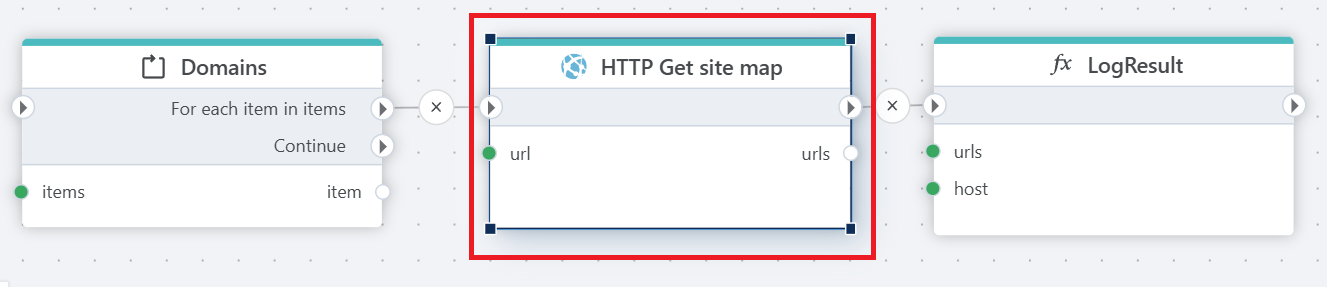
Example 
This flow retrieves a sitemap from a specified URL, validates its structure and content, and throws an exception if the validation fails. You will find a detailed description of this flow here.
Properties
| Name | Required | Description |
|---|---|---|
| Title | No | The name of the operation for retrieving the sitemap. Default: "Get sitemap". |
| Authentication | No | The authentication configuration to use if the website requires it. |
| Sitemap URL | Yes | The URL of the sitemap to be fetched. If the URL does not end with an XML file (e.g., yourwebsite.com), sitemap.xml is automatically appended. If the URL ends with .xml (e.g., yourwebsite.com/sitemap-file.xml), it is regarded as the sitemap. |
| Result variable name | No | The name of the variable where the retrieved sitemap will be stored. Default: "sitemap". |
| Description | No | Additional notes or comments about the action or configuration. |
Returns
List<SitemapEntry>
A list containing entries representing pages found in the sitemap.
SitemapEntry
SitemapEntry {
    Url: string,
    LastModified: DateTime,
    ChangeFrequency: ChangeFrequency
}
ChangeFrequency
Defines how frequently the content at the URL is likely to change.
ChangeFrequency {
    Always,
    Hourly,
    Daily,
    Weekly,
    Monthly,
    Yearly,
    Never
}
HTTP: Videos / Getting started
Generate a PDF file with tabular data
This video shows how to generate a PDF file with tabular data using the Adobe PDF Services API, and download the generated file from an InVision Workbook.
It uses the HTTP trigger and Return File HTTP Response actions to handle the request and return the file.